The valid material thickness range of the Aliencell E1 series (10W / 20W / IR 3W laser modules) is affected by the base configuration (honeycomb panel / base plate). The following data is based on a safety-test environment and applies to the models in this series.
¶ 1. Processing Specifications at a Glance
| Material Thickness (T) | Processing Mode | Key Limitation |
|---|---|---|
| 0.1 mm - 25 mm | Base plate mode | Cutting and engraving supported |
| 0.1 mm - 10 mm | Honeycomb panel mode | Cutting and engraving supported; effectively reduces scorching on the back of the material |
| > 25 mm | Riser columns mode | Engraving supported; for engraving on the surface of bulky materials |
¶ 2. Base Plate Processing
This mode is for thick materials, which are placed directly on the device's base plate; it is suitable for surface engraving on flat, thicker materials. Engraving leaves marks only on the material surface, and the laser does not cut through the material.
Strictly prohibited for cutting:
The laser is reflected by the base plate, scorching the back of the work and leaving blackened or yellowed edges;
Cut marks and burn pits are left on the base plate, which will damage it over long-term use;
Smoke and heat at the bottom of the material cannot escape, seriously affecting cutting quality.
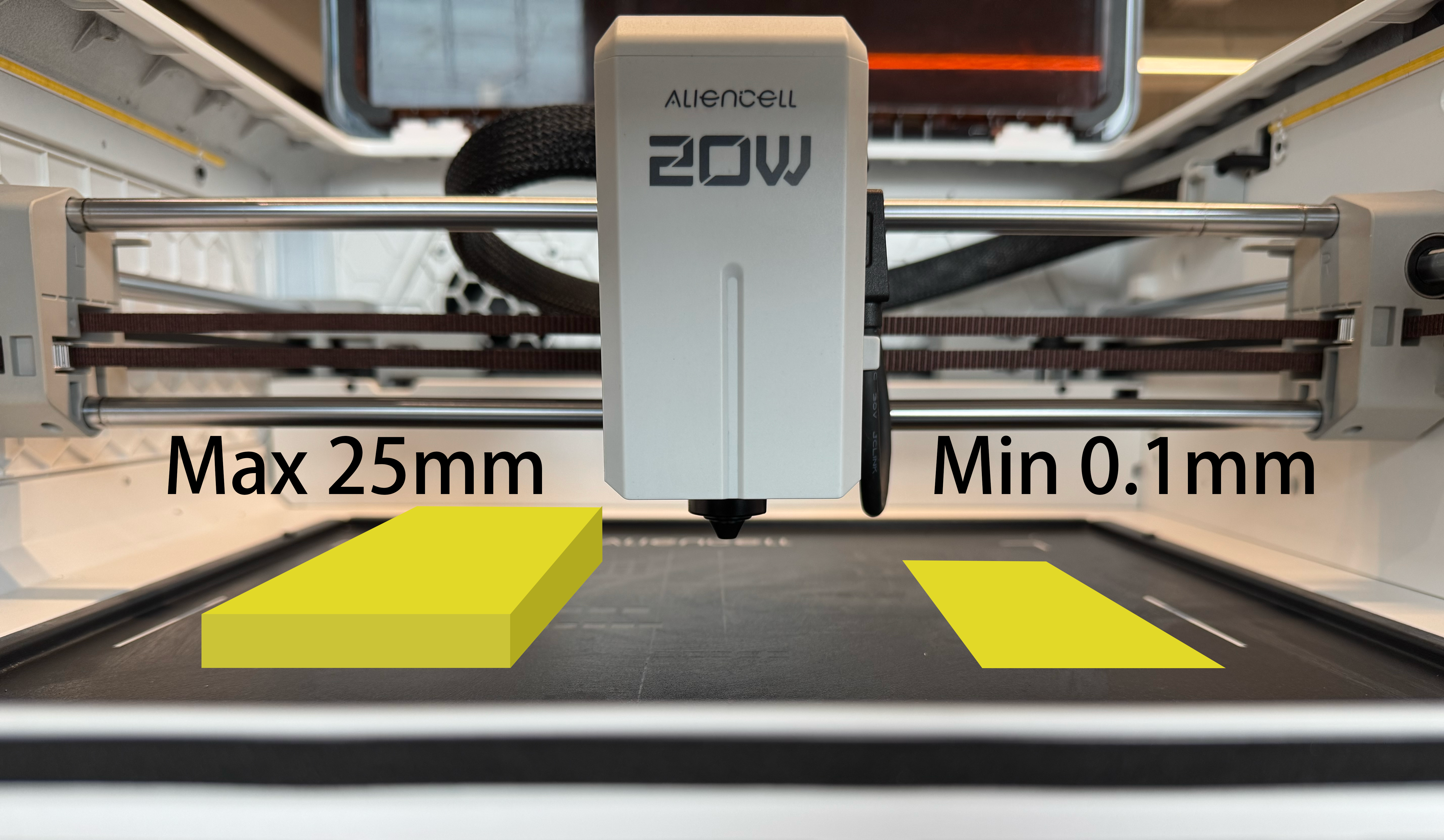
| Minimum processing thickness: 0.1 mm Maximum processing thickness: 25 mm |
|---|
¶ 3. Honeycomb Panel Processing
Suitable for fine cutting and standard sheet processing; it can effectively reduce scorching on the back of the material caused by reflection.
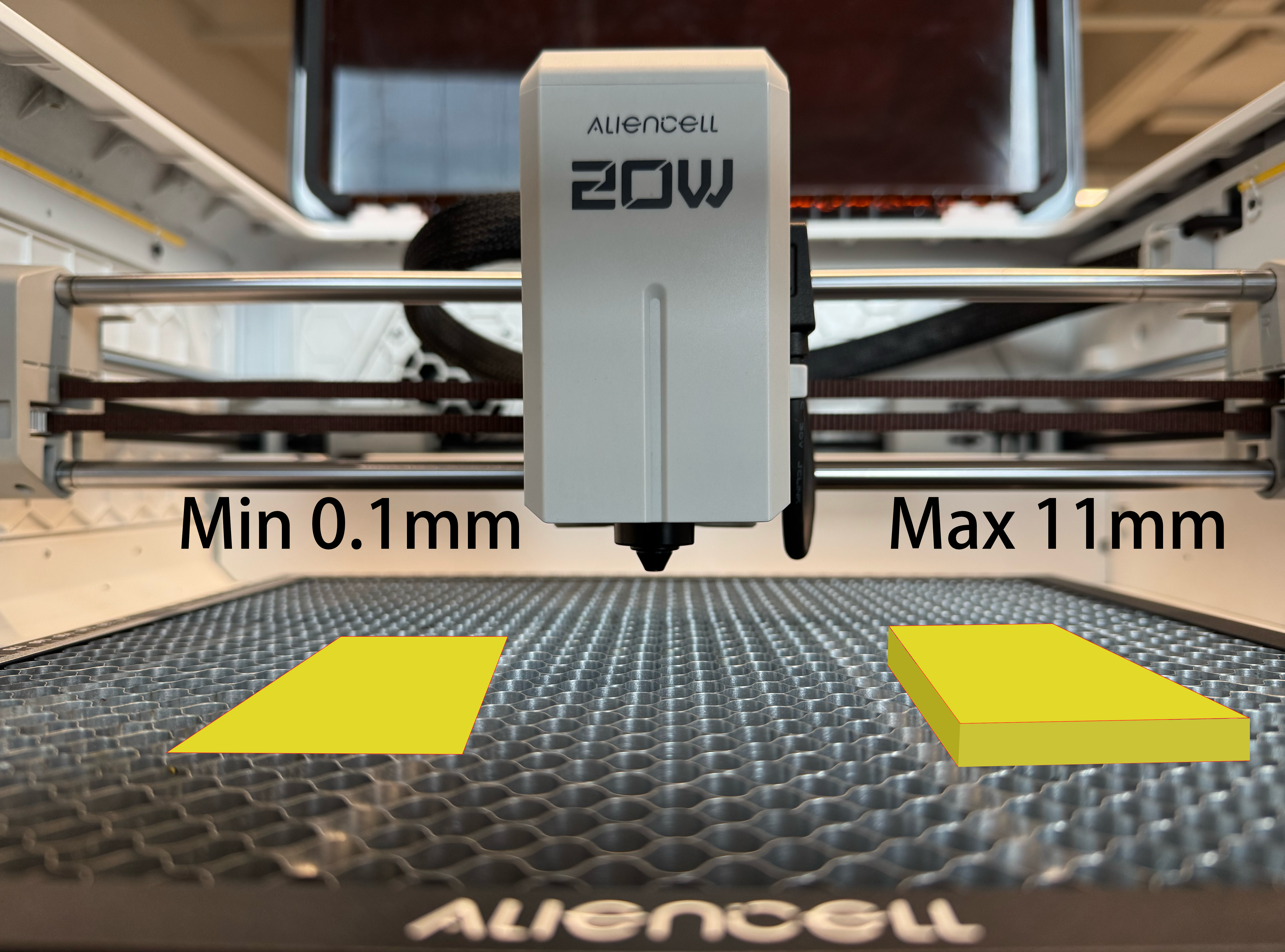
| Minimum processing thickness: 0.1 mm Maximum processing thickness: 10 mm |
|---|
¶ 4. Special Processing Notes
⚠️ Note: When processing 0.1 mm soft materials with the honeycomb panel, if the laser nozzle presses the material down and deforms it, causing focusing to fail, place the aluminum business card from the material pack at the focus position to calibrate the focal distance, or enter the focus distance manually.
Procedure: Move the measurement position to a flat surface, or place a hard-surface material of the same thickness for the distance measurement. After calibration, place the workpiece at the actual processing position.
The measurement data above:
- The limit data is measured on the condition that the surface of the processed material is flat.
- For materials with uneven, curved, or irregular surfaces, the actual processable thickness may need to be reduced accordingly.